
When to leave Opus for Fable 5.2
Fable 5.2 and Mythos 5.2 are the same model. Daily work still starts on Opus 5.5. Only long, open jobs that have to finish themselves are worth the premium. Mythos is a door after verification, not a smarter upgrade.
Decide first whether you leave Opus
Anthropic calls Opus 5.5 the daily driver. Fable is the step up, not the new default.
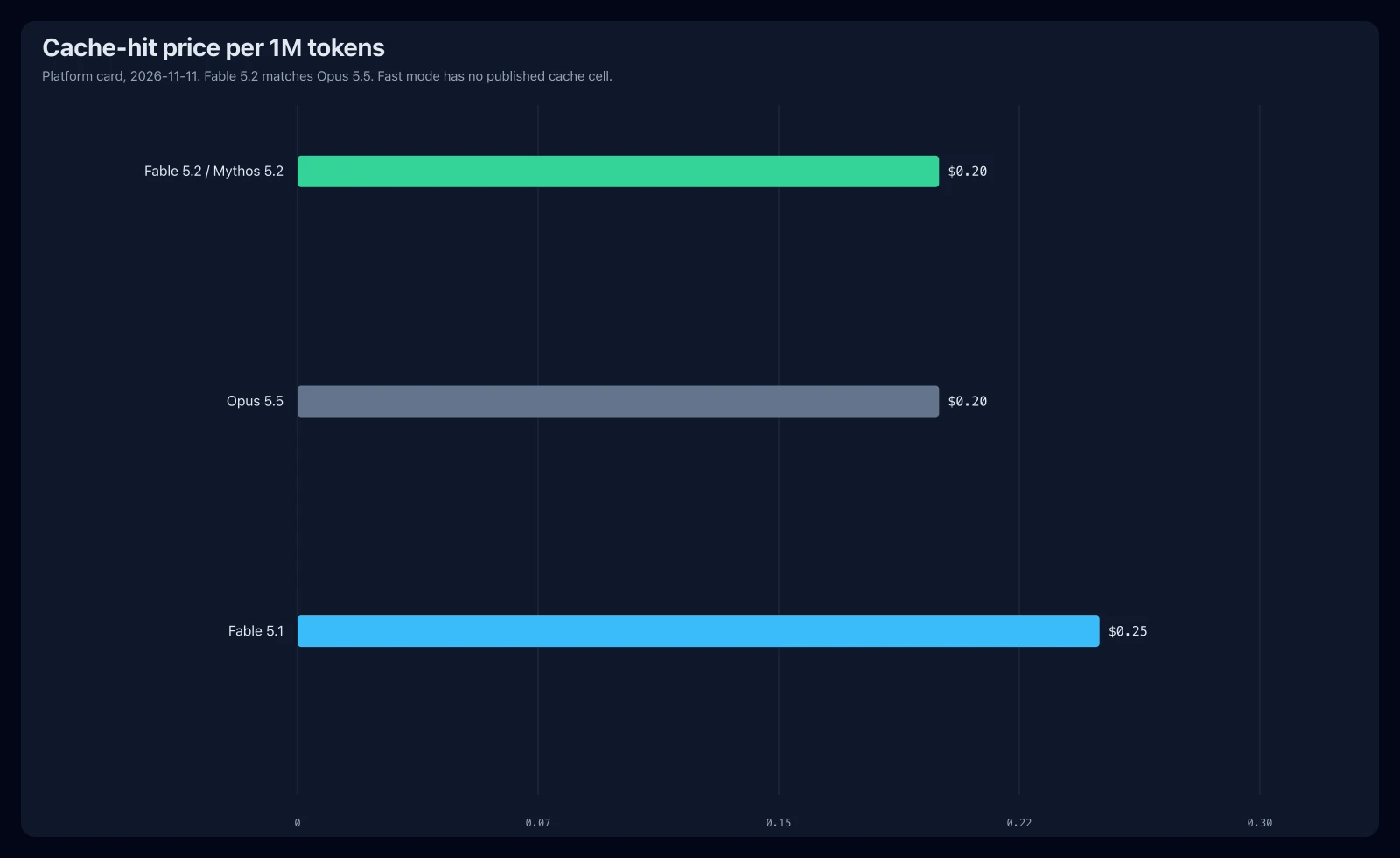
- Scoped coding and knowledge work stays on Opus 5.5. Input / output $4 / $20, cache hit $0.20.
- Long, open work that has to finish itself is when you move to Fable 5.2. The hit price is the same. Input and output are twice Opus: $8 / $40.
- Summaries, classification, and subtasks still go to Sonnet 5.5 or Haiku 5.5. Fable can also sit as advisor or orchestrator. It does not have to take every step.
- Leave Mythos 5.2 off this list for now. It is the same model as Fable. The difference is the door, not the mind.
In the catalog, Fable 5.2 was first seen on 2026-11-10, with a 1,000,000 context and modality text, image, and file in, text out. The OpenRouter primary matches $8 / $40. The batch row is $4 / $20. There is no direct row and no cache column. Cache prices come from the platform card. Fable 5.1 is still there: OpenRouter $10 / $50, batch $5 / $25.
The same model, two doors
The launch post is plain about it. Fable and Mythos are the same underlying model. Fable carries the cyber and biology safeguards, which is why everyone can use it. You apply for Mythos only for the work those safeguards block.
- Cyber goes through Cyber Verification. Life sciences goes through Life Sciences Verification. Without that, do not compare “Mythos is stronger.”
- Enterprise Claude Security can scan repositories with Mythos even if the company is not in the Cyber program. That is a product entrance, not your own API key.
- Fast is $16 / $80 on both, up to about 2.5× generation speed. Mythos Fast is still only for verified organizations. Fast exists on the first-party API, Claude Code, Google Cloud, and Microsoft Foundry.
The specs match. Context is 1M, max output is 128K, the knowledge cutoff is June 2026, and latency is Moderate. Thinking is adaptive and cannot be turned off. The docs table lists default effort as high. The launch post says something else: in the Claude apps and in Claude Code, Medium is the default. Keep both sentences. Price the bill with the default of the surface you actually use.
The sticker fell 20%. It is still above Opus
 Enlarge image
Against Fable 5.1, input, output, and the cache hit are exactly 20% lower. The hit moves from $0.25 to $0.20. Against Opus 5.5 the hit already matches. What still costs more is fresh input and output.
| Model | Input | Output | Cache hit |
|---|---|---|---|
| Fable / Mythos 5.2 | $8 | Best in this comparison $40 | $0.20 |
| Fable 5.1 | $10 | Best in this comparison $50 | $0.25 |
| Opus 5.5 | $4 | Best in this comparison $20 | $0.20 |
| Fable 5.2 Fast | $16 | Best in this comparison $80 | — |
| Opus 5.5 Fast | $8 | Best in this comparison $40 | — |
- A 5-minute cache write is 1.25× input ($10). One hit pays it back. A 1-hour write is 2× ($16). That takes two hits.
- Batch halves input and output. Fable 5.2 becomes $4 / $20, the same as Opus 5.5’s standard sticker. There is no published batch-plus-cache cell, so it is not computed here.
- The Fast sticker is exactly 2×. There is no published price for cache stacked on Fast, so Fast stays out of the bills below.
- US-only inference multiplies by another 1.1. The bills below use global routing and skip that 1.1.
- The launch post says generation is up to about 30% faster than 5.1. That is speed. On Medium, some hard tasks also use fewer tokens. That is a different sentence. Do not add them and say the bill falls 30% by itself.
 Enlarge image
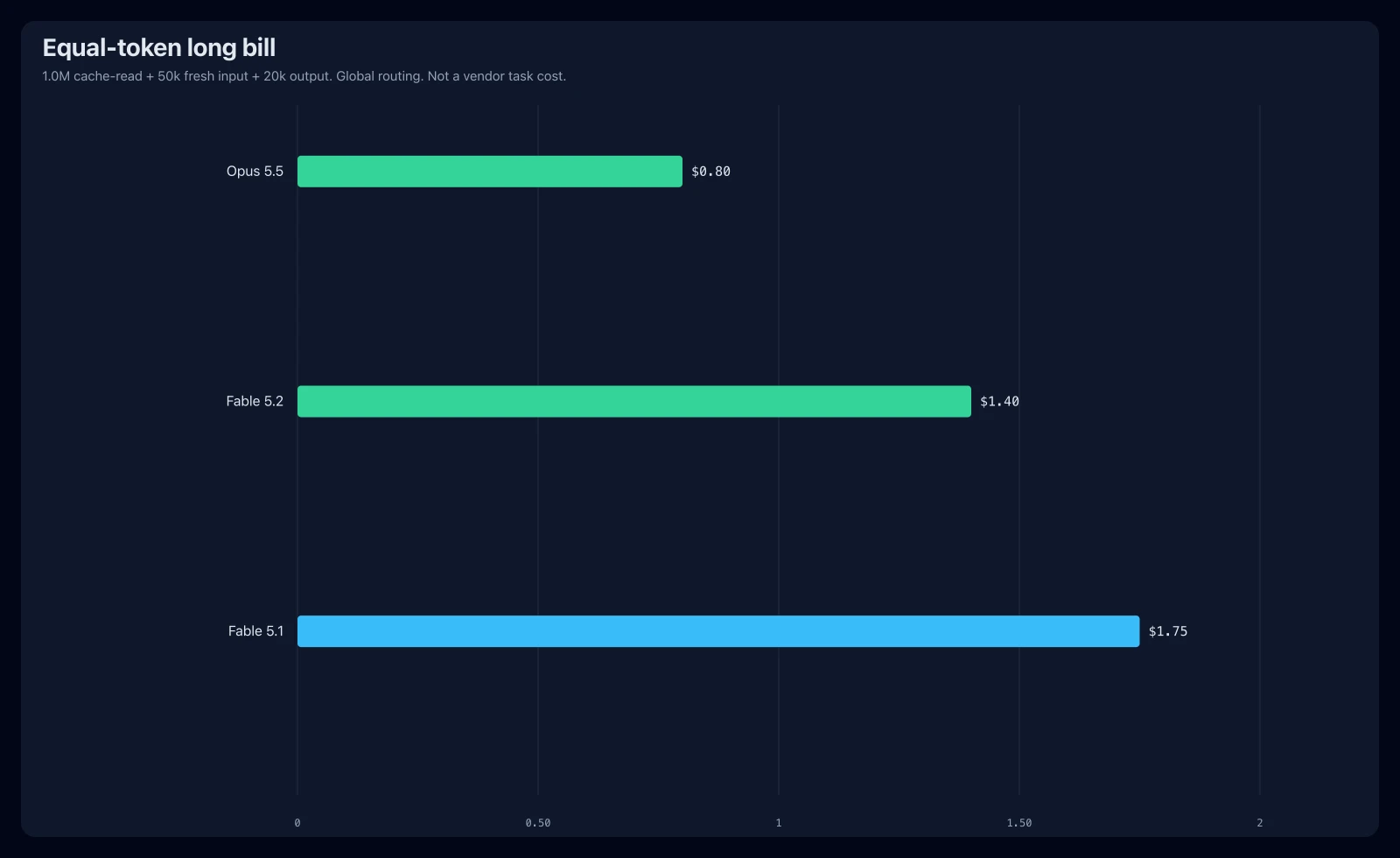
The short request is 80k cache reads, 15k fresh input, and 4k output. The long job is 1.0M cache reads, 50k fresh input, and 20k output. Tokens are locked. Only the standard lane is priced.
| Model | Short | Long |
|---|---|---|
| Fable / Mythos 5.2 | $0.296 | Best in this comparison $1.40 |
| Fable 5.1 | $0.370 | Best in this comparison $1.75 |
| Opus 5.5 | $0.156 | Best in this comparison $0.80 |
On the long job, Fable 5.2’s $1.40 is exactly 80% of Fable 5.1’s $1.75, because the hit, the input, and the output each fell 20%. Against Opus 5.5’s $0.80 it is still 1.75×. The short request is $0.296 against Opus at $0.156, about 1.9×. With almost no cache, the sticker is 80% of 5.1 and exactly twice Opus.
Where the gap is real, and where it is not a reason to switch
 Enlarge image
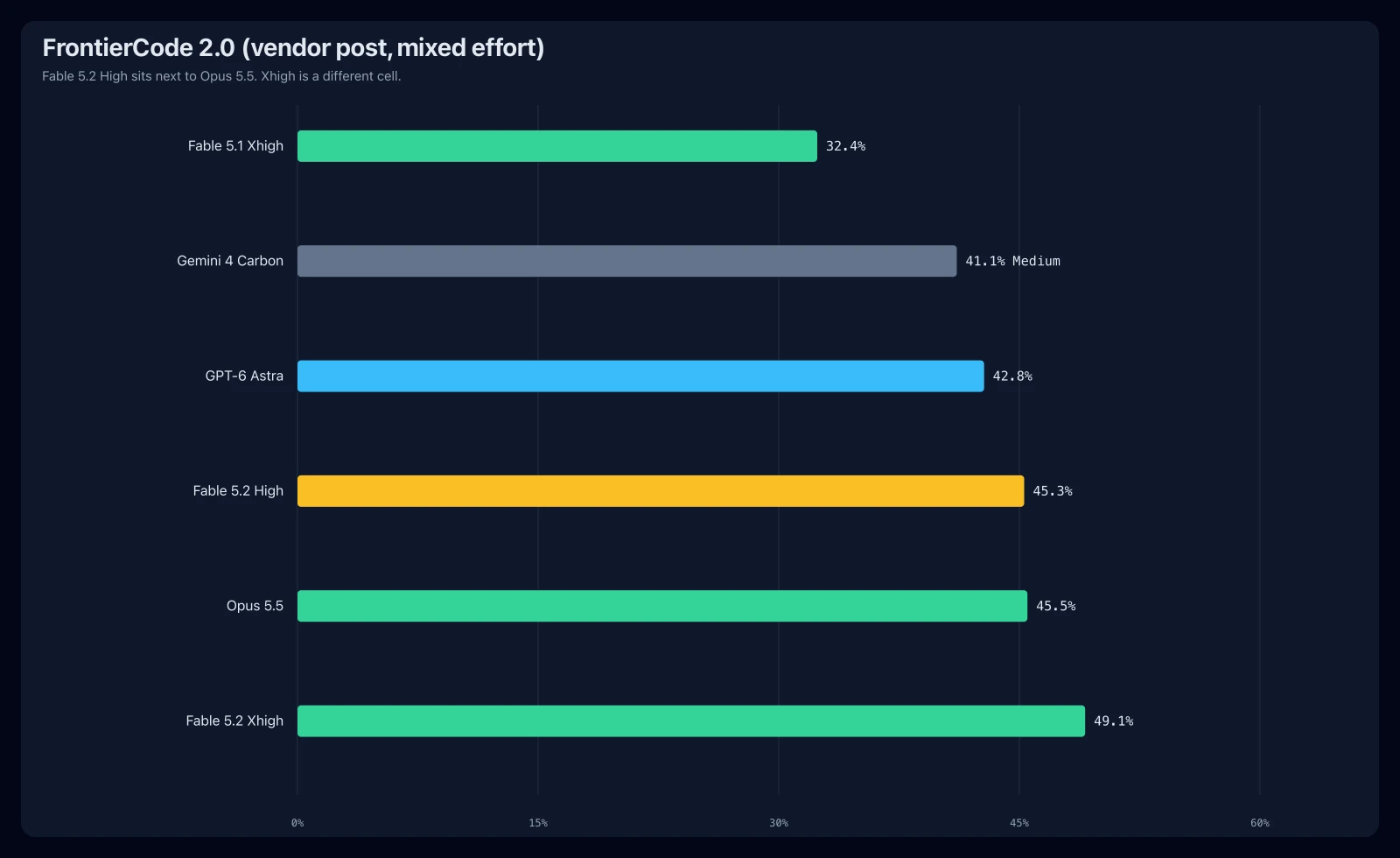
Scores in the table are that model’s highest effort unless the cell says otherwise. Fable 5.2, Fable 5.1, and Opus 5.5 are reported with safeguards on.
| Test | Fable 5.2 | Fable 5.1 | Opus 5.5 |
|---|---|---|---|
| FrontierCode 2.0 | 49.1% Xhigh | 32.4% Xhigh | 45.5% |
| FrontierSWE v2 | Best in this comparison 69.9% | 56.3% | 62.3% |
| TB-Science 0.1 | Best in this comparison 74.6% (Mythos 75.3%) | 52.6% | 58.7% |
| AutomationBench | Best in this comparison 51.4% | 31.4% | 42.5% |
- FrontierCode asks whether the change would merge. Xhigh at 49.1% is the top cell. High is about 45.3%, level with Opus 5.5 at 45.5%. The post says that cell costs about half as much per task. Do not fold the two cells into “it has already passed Opus everywhere.”
- FrontierSWE v2 is 69.9 against Opus at 62.3, and above Astra at 65.5. On TB-Science, Fable is 74.6, Mythos is 75.3, and Opus is 58.7. That is a science terminal task, not an everyday bug fix.
- On AutomationBench, Fable 5.2 is 51.4, under Gemini 4 Carbon at 53.9. The loss stays in the piece.
- On AA-Briefcase the rubric is 66.1, above Opus at 61.2. The Elo is 1785, below Opus at 1800. The two point in opposite directions. Do not quote only the higher one.
- The Chartography table is 73.4 with no tools. Medium on the cost chart is 66.4. Do not mix them. On CyScenarioBench each lab’s tasks differ. RoboDojo at 64.9 is an internal run at the highest effort.
- CVE Rediscovery at 89.6 is Mythos. The post also says that on Anthropic’s own evaluation, finding vulnerabilities is roughly level with Opus 5.5, and at the same time “10.2% more” than Opus and “14.4% more” than Mythos 5.1. Keep both sentences.
The operating system, Fermat’s Last Theorem, the black-hole calculations, and the three boards are Anthropic’s own prerelease experiments. Each is one example. They do not enter this table.
Three things that change when you switch
- Safeguards and fallback. On cyber requests, Fable 5.2 falls back to Opus 4.8. On biology, it falls back to Opus 5. Early testing saw about 55% fewer blocks than Fable 5.1: about 60% fewer in cyber and 40% fewer in biology. Fewer, not none. Mythos is the same model with those safeguards removed. Kernel optimization and changes to model architecture are held near Opus 5.5; a small set of related topics falls back transparently to Opus 5. Everyday coding is not on that list.
- The default effort does not match. The API docs table says high. The Claude apps and Claude Code say Medium. If you turn effort up to high because the docs say so, the bill leaves the cell that was level with Opus. Look at the surface you actually use.
- You cannot rewrite what it already wrote. Preserved thinking now applies to every account. You cannot edit prior context to pull out the reasoning. A conversation does not move to another account for free.
Do not write privacy as zero retention for everyone. Enterprise can keep zero data retention before Enterprise Frontier Safeguards is connected; that monitoring is in private beta. Other customers have 30-day retention for safety monitoring.