
How to choose among Claude 5.5
Scoped work goes to Sonnet. Long, fuzzy work that has to finish itself goes to Opus. Summaries, classification, and subtasks go to Haiku, as long as one prompt stays under 100,000 tokens. All three are already in the catalog.
Pick the tier before the price
All three have a 1M context and a June 2026 knowledge cutoff. What changes is the job you hand them.
- Sonnet 5.5 for bugs, docs, slides, and UI. Input / output $2 / $10, cache hit $0.10. In the Claude apps the default effort is medium, and that is the region where it stays cheaper than Opus. On the Platform the default is high, and the bill moves toward Opus.
- Opus 5.5 for multi-repo work, fuzzy edges, and jobs that have to close themselves. $4 / $20, cache hit $0.20. Thinking cannot be turned off. Turn on Fast only when latency matters: the same tokens cost about twice as much, and only on the first-party API.
- Haiku 5.5 for compaction, summaries, classification, support, and subtasks under the other two. At or under 100,000 tokens it is $0.10 / $0.50, cache hit $0.01. Cross that line and the whole request becomes 5×, not just the overflow.
- Leave Fable 5.1 at $10 / $50. It is no longer the default for coding.
Catalog first seen: Opus 2026-09-23, Sonnet 09-30, Haiku 10-08. The OpenRouter primary matches the input and output above. Haiku’s row is only the under-100k tier. None of the three has a direct-API price or a cache column.
Read the cache hit, not the sticker
 Enlarge image
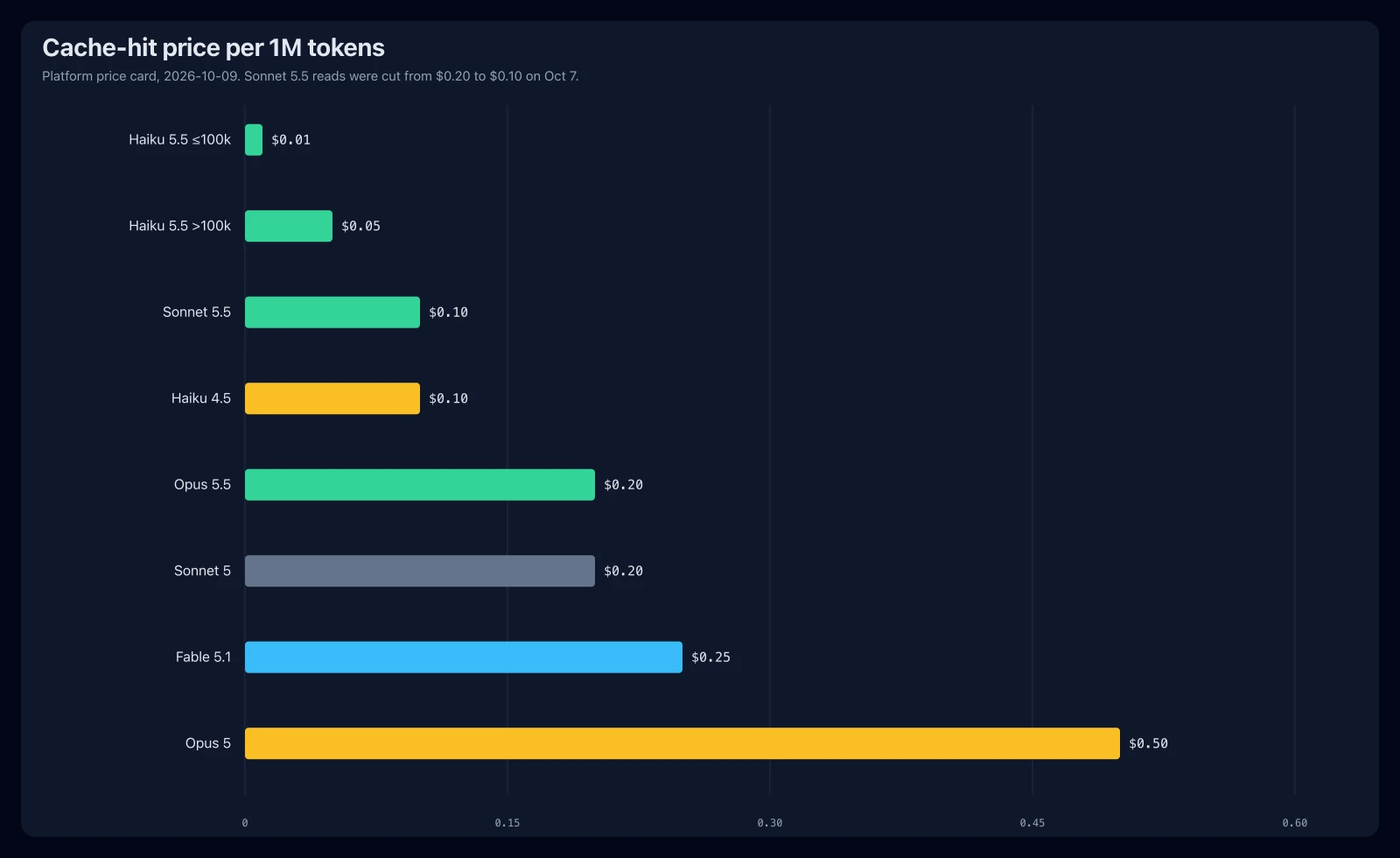
On coding and long chats, most tokens are cache reads, not fresh input. The input and output stickers barely moved. The hit price did: Sonnet from $0.20 to $0.10, Opus from $0.50 to $0.20.
| Model | Input | Output | Cache hit |
|---|---|---|---|
| Opus 5.5 | $4 | Best in this comparison $20 | $0.20 |
| Opus 5 | $5 | Best in this comparison $25 | $0.50 |
| Sonnet 5.5 | $2 | Best in this comparison $10 | $0.10 |
| Sonnet 5 | $2 | Best in this comparison $10 | $0.20 |
| Haiku 5.5 ≤100k | $0.10 | $0.50 | Best in this comparison $0.01 |
| Haiku 5.5 >100k | $0.50 | $2.50 | Best in this comparison $0.05 |
| Haiku 4.5 | $1 | Best in this comparison $5 | $0.10 |
| Fable 5.1 | $10 | Best in this comparison $50 | $0.25 |
- A 5-minute cache write is 1.25× input and pays for itself on one hit. A 1-hour write is 2× and pays for itself on two hits.
- Batch is half price on input and output. The pricing page does not print the cell after cache is stacked on top, so it is not calculated here.
- Asking for US-only inference multiplies the whole bill by 1.1. The bills below use global routing.
- Haiku’s 100,000 counts cache reads and writes. 99,000 and 100,001 is not a small surcharge. The entire bill becomes 5×.
- Do not read $1 → $0.10 as “the bill becomes a tenth.” The new tokenizer emits about 30% more tokens for the same text. Anthropic’s “about 75% less on average” already includes that.
Same tokens, two bills
 Enlarge image
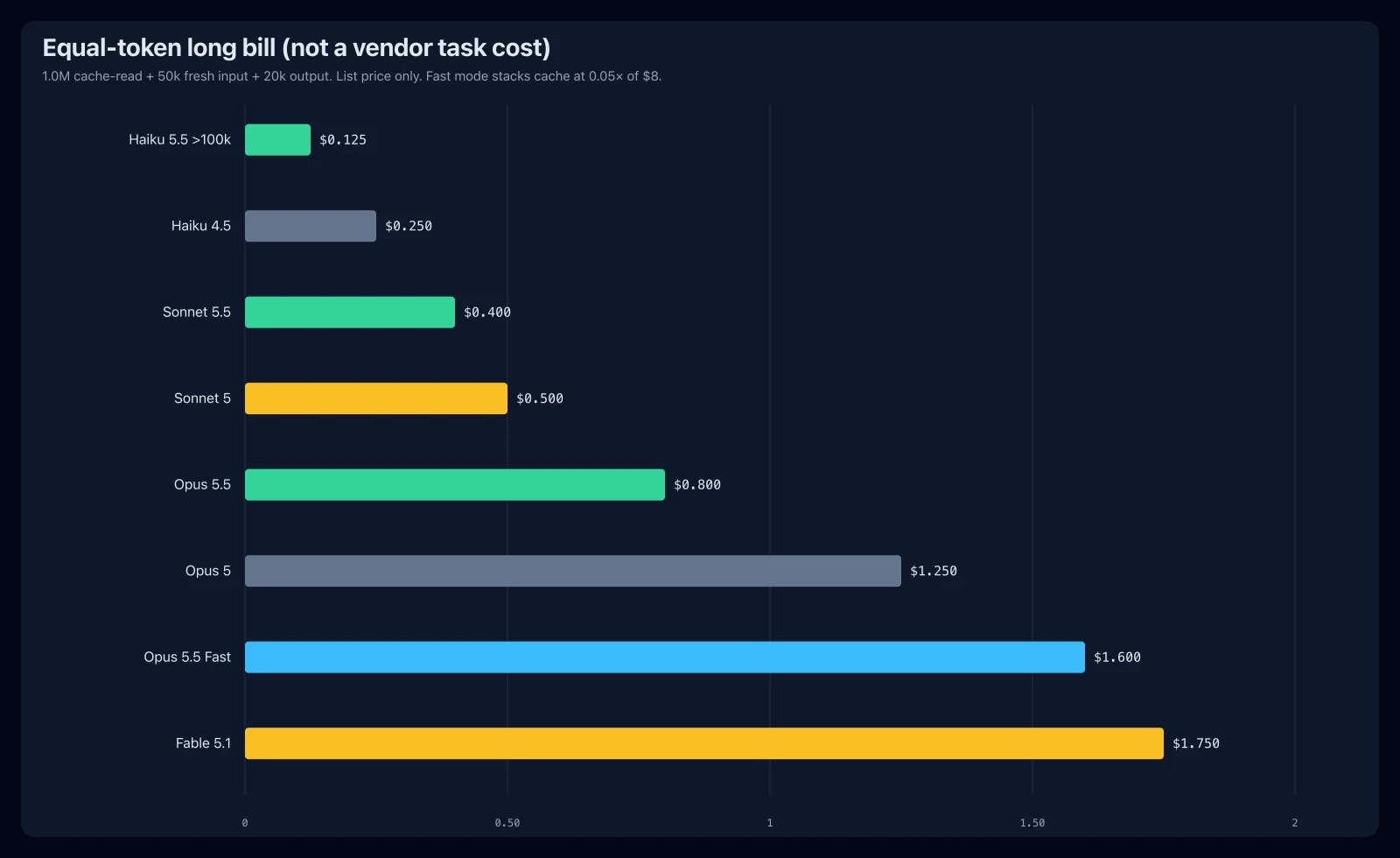
“40% / 30% / 75% cheaper” mixes two changes: the sticker moved, and the token count for the same job moved. The table freezes the tokens.
The short request is 80,000 cache reads, 15,000 fresh input, and 4,000 output. The prompt is 95,000, so Haiku stays on the low tier. The long task is 1,000,000 cache reads, 50,000 fresh input, and 20,000 output. The prompt is over 100,000, so the whole Haiku request takes the high tier.
| Model | Short | Long |
|---|---|---|
| Haiku 5.5 | $0.0043 | Best in this comparison $0.125 |
| Haiku 4.5 | $0.043 | Best in this comparison $0.250 |
| Sonnet 5.5 | $0.078 | Best in this comparison $0.400 |
| Sonnet 5 | $0.086 | Best in this comparison $0.500 |
| Opus 5.5 | $0.156 | Best in this comparison $0.800 |
| Opus 5 | $0.215 | Best in this comparison $1.250 |
| Opus 5.5 Fast | $0.312 | Best in this comparison $1.600 |
| Fable 5.1 | $0.370 | Best in this comparison $1.750 |
- On the long task, Opus 5.5 is $0.80 and the previous Opus is $1.25, 36% less. Their ~40% also includes fewer tokens, and that part is not in the table.
- Sonnet 5.5 is $0.40 and the previous Sonnet is $0.50, exactly 20% less. If you have almost no cache, the sticker matches Sonnet 5 and the savings are only the shorter token count.
- On the short request, Haiku 5.5 is $0.0043: about 1/18 of Sonnet and 1/36 of Opus. That is why it belongs on subtasks. Past 100,000 tokens, that gap shrinks.
Sonnet wins one cell. Don’t retire Opus for it
 Enlarge image
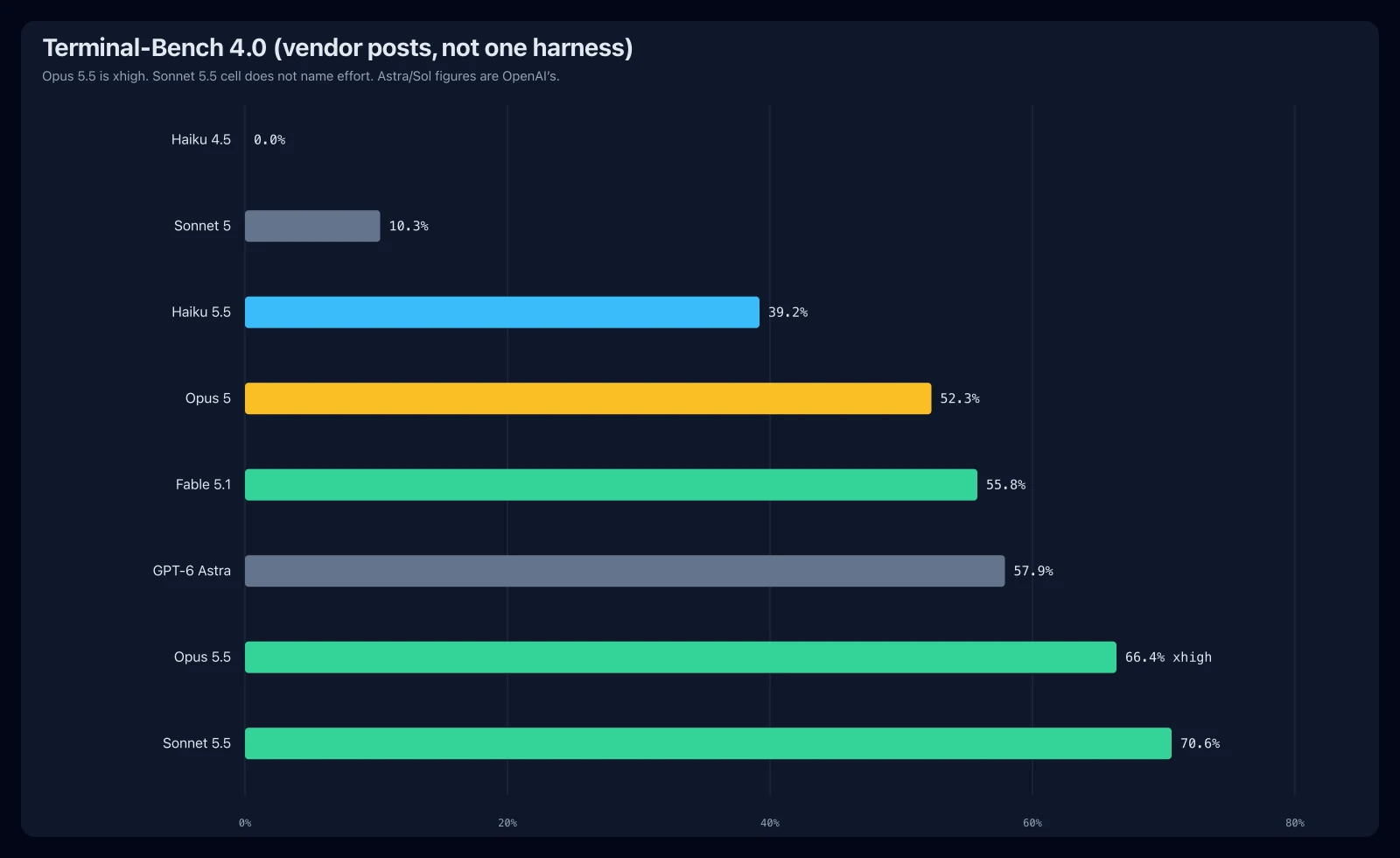
The table keeps only the headline number. Three sentences matter more than memorizing the grid.
| Test | Haiku 5.5 | Sonnet 5.5 | Opus 5.5 |
|---|---|---|---|
| Terminal-Bench 4.0 | 39.2% | Best in this comparison 70.6% | 66.4% |
| FrontierCode | 46.4% | 52.1% | Best in this comparison 54.4% |
| CursorBench | — | 55.5% | Best in this comparison 57.8% |
| GDPval-AA | 1620 | 1844 | Best in this comparison 1846 |
- On Terminal-Bench, Sonnet is 70.6% and Opus is 66.4%. Opus says that figure is xhigh, its maximum. Sonnet’s cell does not name an effort. The previous Sonnet is 10.3% and Haiku 4.5 is 0. That is a break from the last generation, not “it has already passed Opus everywhere.”
- FrontierCode asks whether the change would merge. Opus is about 54%. Sonnet is 52.1% at xhigh and drops to 46.2% at max, because the review splits across too many subtasks and edits past the task. Turning effort all the way up makes this table worse.
- On CursorBench, Sonnet’s 55.5% sits between Opus at medium (52.5%) and Opus at max (57.8%). That is not a stable second place. GDPval is a near tie, 1844 against 1846. The Haiku post prints Sonnet as 1840; four points, same band.
- Do not mix two charts. Chartography is sometimes with tools and sometimes without. OSWorld’s partial score and its offline score are not the same set.
- Opus does not win every cell. On AutomationBench, GPT-6 Astra is 41.4% and Opus is 40.0%. On the science terminal task, Astra is 64.6% and Opus is 58.7%. Safeguard fallbacks pull the number down, because a different model finishes the task.
Anthropic says these gaps are wider than the difference they see in their own use. Open-ended work that needs judgment the whole way is still Opus.
Three things that change when you switch
- Thinking. Opus 5.5 cannot turn it off. Text between tool calls comes back, by default, in empty thinking blocks. If you showed that text as progress, it goes quiet until you change display. If Sonnet was running with thinking off, switch it to between_tools before you move.
- Tied to the account. On API accounts created on or after 2026-08-31, Opus 5.5 will not let you rewrite what it already wrote in order to pull out the reasoning. Sonnet 5.5 is the first Sonnet that works this way. Moving a conversation to another account, or switching accounts mid-session in Claude Code, hits that.
- The safety fallback. On cyber requests, most of Opus 5.5 falls back to Opus 4.8 and Sonnet 5.5 falls back to Sonnet 5. Everyday bug fixing still runs. Haiku allows more defensive work and still blocks penetration testing. If Opus blocks biology work, the path is the Life Sciences review. Sonnet and Haiku use the same biology safeguards as Sonnet 5.
Zero data retention is stated for Opus 5.5 and Sonnet 5.5. The Haiku post does not say it, so it is not added here. The monthly Max and Team API credit is not a discount: 5x is $100, 20x is $200, and Team is up to $500 shared across members.