
Build a local coding model: stack, weights, VRAM bands
Stacks are cheap to change; model size locks hardware. Weights fitting VRAM is not the same as fitting your context. Check the API 100K+20K bill before buying a card.
Order: stack → model → hardware
Hardware is the expensive lock, so the page walks cheap-to-dear. Many people already have a Mac or a 24GB card — the wizard runs in reverse from memory. Start at the [local coding hub](/en/local-coding/).
| Platform | Stack |
|---|---|
| Desktop NVIDIA | Ollama → llama.cpp → vLLM/SGLang (dedicated box) |
| Apple Silicon | MLX first; llama.cpp / Ollama for GGUF portability |
| Laptop | Never start with vLLM |
| IDE | Point Continue / Aider / Cline at localhost |
Do not start with vLLM on a laptop. Prefer MLX on Apple Silicon; use llama.cpp / Ollama when you need portable GGUF. Point the IDE at localhost and use the [Agent](/en/agent/) and [Toolchain](/en/toolchain/) boards for repos. Decision tree: [software stack](/en/local-coding/stack/).
Only downloadable coding weights that fit a consumer band
Do not name-heuristic Claude or GPT into “local coding.” The allowlist requires an open license, downloadable weights, and a Q4 footprint that matches a desk band. 480B / 284B MoE is an API or a rack, not a 24GB download. The on-site composite rewards long context and low list price — not SWE. Vendor SWE-Pro is not an independent harness.
Tables and same-job OpenRouter prices: [models](/en/local-coding/models/). Single-card case study: [Qwen3.8-27B review](/en/insights/qwen3-8-27b-review/).
VRAM bands: memory is the lock, not TFLOPS
 Enlarge image
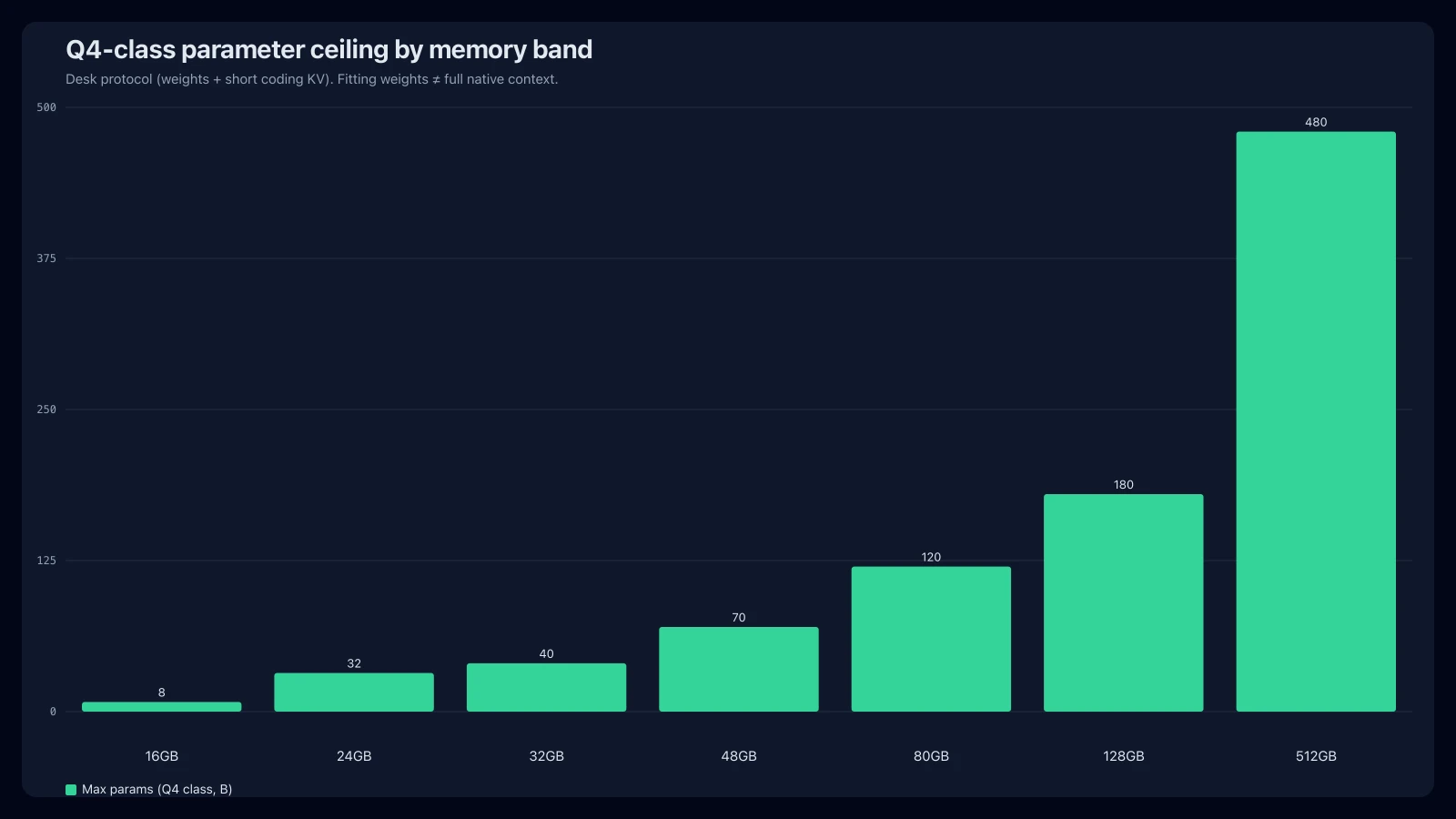
 | Band | Typical class | Max params (Q4 class) | Workloads |
|---|---|---|---|
| 16GB | RTX 4060 / 5060 Ti 16GB class | 8B Q4 class | complete |
| 24GB | RTX 4090 24GB | 32B Q4 class | complete, agent |
| 32GB | RTX 5090 32GB class | 40B Q4 class | complete, agent, long |
| 48GB | 48GB workstation / dual-24 class | 70B Q4 class | complete, agent, long |
| 80GB | 80GB-class pro card | 120B Q4 class | complete, agent, long |
| 128GB | Mac Studio 128–192GB | 180B Q4 class | complete, agent, long |
| 512GB | Mac Studio 512GB | 480B Q4 class | complete, agent, long |
Weights fitting the card ≠ target context fitting. KV cache grows with the window; 27B Q4 on 24GB is an 8K–32K coding-agent on-ramp, not native 262K. Apple unified memory prefers MLX; NVIDIA pairs with CUDA stacks. Mac Studio is expensive but operationally simple — not a free lunch. Protocol and do-not-buy list: [hardware](/en/local-coding/hardware/).
TCO: token stickers are zero; electricity and depreciation are not
 Enlarge image
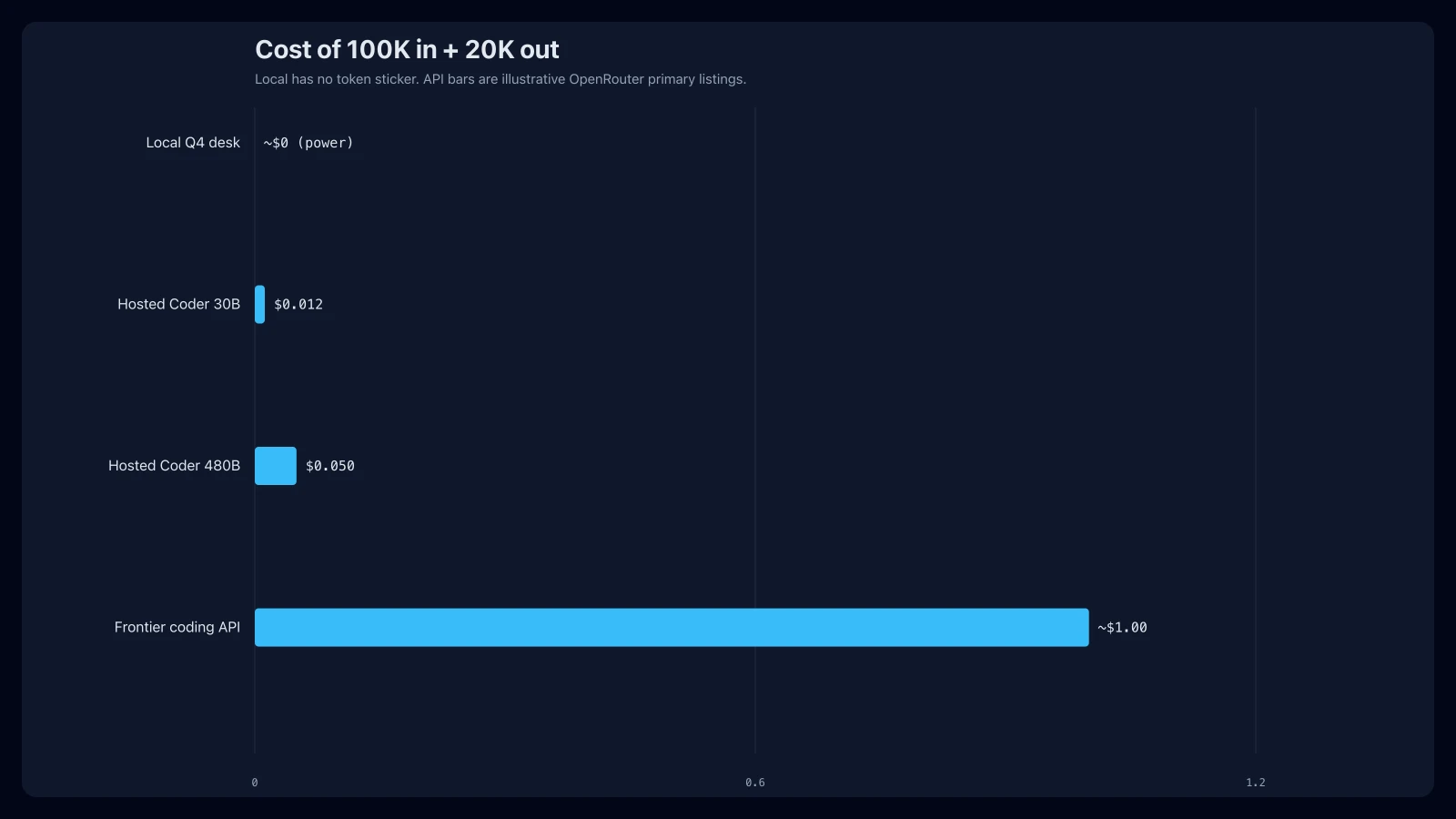
 Illustrative break-even: 3-year capex plus ~40 hours/month at 250W and $0.15/kWh. You need N 100K+20K coding jobs per month to match a consumer card. Tab-complete often never breaks even — keep paying the API. Do not buy: 70B on ≤16GB; a 4090 expecting Coder 480B; H100 for personal SWE.
[choose-ai-infrastructure-guide](/en/insights/choose-ai-infrastructure-guide/) is API-host selection, not desk GPUs. Quantitative trade-offs live in the [local coding wizard](/en/local-coding/).